.png)
60% Value Drop? The Real Reason Chinese Bikes Depreciate Faster Than Japanese & British Makes

If you have walked into a motorcycle showroom recently, you’ve likely noticed a massive influx of Chinese-manufactured motorcycles. Brands like CFMOTO, Kove, Voge, QJMotor, and Lexmoto are filling dealership floors, offering sharp styling, high-tech TFT dashes, and premium components from names like Brembo and Bosch—all at a fraction of the cost of a new Honda, Yamaha, or Triumph.
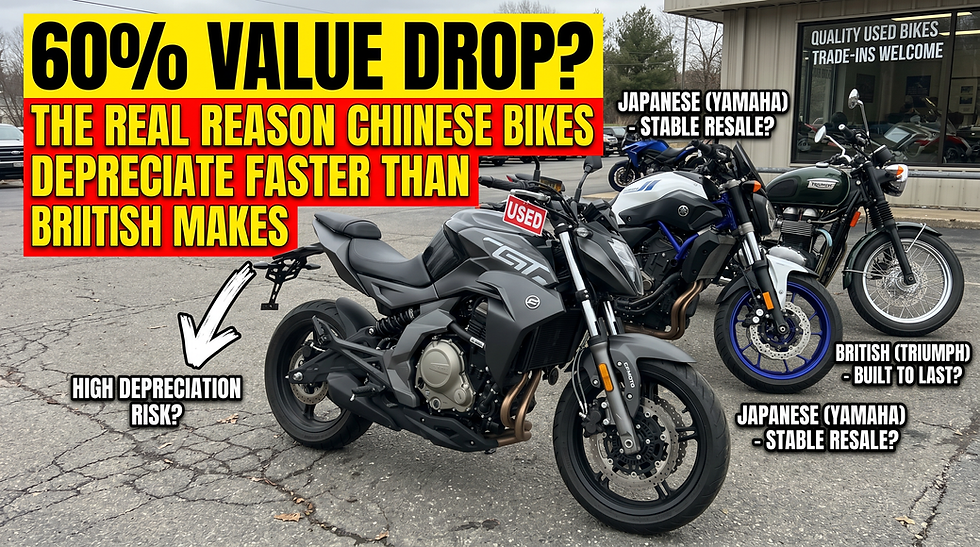
On paper, a brand-new Chinese motorcycle looks like an absolute steal. But scratch beneath the surface, and a harsher reality emerges for owners looking to trade up or sell their machines.
The used motorcycle market is brutal to Chinese-made bikes. While a Japanese or British motorcycle might lose 15% to 25% of its value in its first couple of years, many Chinese motorcycles suffer a staggering 40% to 60% drop in value the second they roll off the forecourt.
If you are an owner watching your bike's residual value plummet, or if you’re currently struggling to find a private buyer willing to give you a fair price, this guide explains exactly why this massive depreciation gap exists. We will also look at how shifting global market dynamics, extreme development cycles, and sudden brand closures are leaving owners stranded, and how anybikebought.com can help you get out of the depreciation trap before it’s too late.
1. The Trust and Legacy Gap (Japanese vs. Chinese Engineering)
The single biggest driver of motorcycle depreciation is consumer trust.
Manufacturers like Honda, Yamaha, Kawasaki, and Suzuki have spent more than six decades building an ironclad reputation for bulletproof reliability. If a buyer purchases a 10-year-old Suzuki SV650 with 30,000 miles on the clock, they do so with absolute confidence that the engine will run flawlessly for another 30,000 miles. British legacy brands like Triumph carry massive prestige and a dedicated community that props up used prices.
Chinese brands, by comparison, are still in the infancy of their global brand-building phase. While mechanical build quality has vastly improved—moving away from the notoriously fragile "Chinesium" metals of the early 2000s to robust, modern parallel-twins—the perception of lower quality remains firmly stuck in the minds of the buying public. Second-hand buyers are inherently risk-averse; given the choice between a used, unproven Chinese model and a slightly older Japanese machine for the same price, the Japanese bike wins nearly every time. This lack of demand forces used prices through the floor.
2. Predatory New Pricing Tanks the Used Market
Chinese manufacturers are incredibly successful at utilizing an aggressive strategy known as market penetration pricing. Backed by massive manufacturing infrastructure and state development subsidies, these brands deliberately enter Western markets with their new bikes priced drastically lower than the competition to steal market share.
While that is great for a new buyer, it is catastrophic for resale value:
The New vs. Used Dilemma: If a brand-new Chinese 400cc sports bike costs £4,000, a one-year-old used one can realistically only be listed for around £2,500 to attract a buyer. Why would anyone risk buying a used machine when they can get a brand-new one with a full warranty for just a little bit more cash?
Hyper-Accelerated Product Lifecycles: Japanese and British brands typically refresh their models every 4 to 5 years, keeping older generations looking relevant and holding their value. Chinese brands iterate at an almost frightening speed. For example, brands like Kove have completely redesigned their core street models (like the 450R and 450RR platforms) multiple times just two or three years after their initial global debuts. The moment a manufacturer drops a heavily revised version with better tech, the previous model instantly looks outdated, causing its market value to crash immediately.
3. The Parts and Dealership Nightmare: Brands Going Bust
When you buy a motorcycle, you aren't just buying the metal and rubber—you are buying into a long-term support network. If a fuse blows or a sensor fails on a Triumph or a Kawasaki, you can call any local dealer and have an OEM (Original Equipment Manufacturer) part delivered within 24 to 48 hours.
With many Chinese bikes, finding parts for a five-year-old machine can feel like an archaeological expedition. This issue is amplified by the sheer volatility of the budget motorcycle market. Over the years, countless Chinese brands, import startups, and distributors have gone entirely bust or vanished overnight, leaving owners with zero manufacturer support.
The Danger List: Vanished and Volatile Brands
Many budget and Chinese-sourced brands have struggled with financial stability, restructuring, or have quietly folded their UK/European distribution networks entirely over the last decade. Brands like Sinnis, WK Bikes, Zongshen (older UK imports), Herald, and various generic white-label scooter importers have seen models completely orphaned when local distributors pull the plug.
Even massive global players aren't immune to severe financial stress. For example, European motorcycling giant KTM—
which has deeply integrated manufacturing ties with Chinese powerhouse CFMOTO—faced severe liquidity crises and massive debt restructurings, sending shockwaves through dealership networks regarding future stability.
The Spares Trap: In China, strict domestic laws historically made it illegal to operate motorcycles over 13 years old, meaning manufacturers faced very little domestic pressure to produce long-term spare parts cataloguing. If your bike's brand goes bust or pulls out of the UK market, tracking down basic mechanical parts requires scouring obscure corners of the internet, cross-referencing factory engine stamps, or guessing which parts are interchangeable.
Because local independent garages hate having their workshop ramps clogged up for weeks waiting for untraceable parts, many mechanics simply refuse to work on Chinese motorcycles. Used buyers know this, and they protect themselves by offering pennies on the pound.
The Used Bike Depreciation Comparison
To illustrate how deep the depreciation curve runs, look at how typical Chinese motorcycles compare to their Japanese and British counterparts over a three-year period:
Feature/Metric | Chinese Brand (e.g., Kove / Voge / Lexmoto) | Japanese Brand (e.g., Honda / Suzuki) | British Brand (e.g., Triumph) |
Year 1 Depreciation | 35% - 45% | 15% - 20% | 15% - 22% |
Year 3 Depreciation | 55% - 70% | 30% - 35% | 30% - 40% |
Dealer Network Strength | Limited / Fragmented | Widespread & Stable | Widespread & Prestigious |
Parts Availability | Difficult to unpredictable | Guaranteed (Next day) | Guaranteed (Next day) |
Garage Acceptance | Often refused by independents | Universally accepted | Universally accepted |
Private Resale Liquidity | Very Low (Months to sell) | High (Days to weeks) | High (Days to weeks) |
Stuck with a Chinese Motorcycle? Why Private Selling is a Nightmare
If you currently own a Chinese motorcycle or scooter and are trying to sell it privately to recoup some money, you've likely run into a brick wall. Listing a Chinese bike on online marketplaces usually exposes you to a specific type of selling friction:
Endless Lowballers: Because the public associates the bikes with bargain-basement pricing, you will be hit with insulting offers well below your listing price.
The Tech/Feature Paradox: You might point out that your bike has Bluetooth connectivity, upside-down forks, and riding modes, but private buyers will look past the features and focus solely on the unproven badge on the tank.
Zero Buyer Confidence: As soon as a private buyer asks, "Where can I get this serviced nearby?" or "Is it easy to get a new clutch cable?" and you can't give a straightforward answer, the sale completely falls through.
Sell Your Chinese Motorcycle the Hassle-Free Way with AnyBikeBought.com
You don’t have to let your motorcycle sit in the garage gathering rust, losing battery charge, and depreciating down to absolute zero. If you are struggling to find a private buyer or if main dealerships are turning up their noses at your trade-in, anybikebought.com is here to help.
We are specialist buyers of all types of motorcycles, including the entire spectrum of Chinese makes and models. Whether you have a premium adventure bike or Dakar-inspired model from Kove or CFMOTO, a learner-legal commuter from Lexmoto or Sinnis, or even an older model from a brand that has gone out of business, we want to buy it from you.
1.Submit Your Registration:Takes 2 minutes.
Go to our homepage at anybikebought.com and enter your registration number, mileage, and a brief, honest description of your bike's condition.
2.Receive a Real Valuation:No automated lowballs.
Our team of bike enthusiasts evaluates your machine accurately based on real-world market values, taking any extra features or accessories into account.
3.Free Home Collection & Instant Cash:Within 24-48 hours.
We come directly to your home or workplace anywhere in the UK to collect the bike. We transfer the agreed funds directly to your bank account on the spot—we don't leave with the bike until you confirm the money has safely cleared.
Bypass the depreciation trap completely. No tyre-kickers, no listing fees, and no stress about parts supply or dealer support. Turn your bike into guaranteed cash today.🌐 Get Your Instant Free Valuation at AnyBikeBought.com
Frequently Asked Questions (FAQs)
Will you buy my Kove or CFMOTO bike if it has aftermarket parts?
Yes! Many owners upgrade these bikes with custom screens, luggage, or exhaust systems. Unlike traditional dealers who undervalue modified Chinese machines, our team treats your bike individually and gives you a fair price for your complete setup.
Will you buy my Chinese bike if the manufacturer has gone bust?
Yes! Genuine orphaned brands can be a nightmare for a private seller, but we buy motorcycles from defunct or struggling manufacturers. Our evaluation will simply reflect the current market state, giving you a fair path out of a difficult asset.
Do you buy non-runners or bikes with electrical issues?
Absolutely. Electrical gremlins and minor component failures are common on older budget models. We buy bikes in any condition—whether it's an immaculate garage queen or a non-running project taking up valuable workshop space.
My bike has cosmetic scuffs and rust. Will you still take it?
Yes. We understand that many lightweight Chinese commuter bikes live outdoors and handle the harsh British winter weather. Just be clear about the condition when submitting your details, and we will tailor a fair offer.
For a deeper dive into the challenges currently facing manufacturing chains and the health of global two-wheeler enterprises, check out this detailed look at motorcycle brands facing financial risk, which highlights why parts availability and company stability are becoming major concerns for buyers.


Comments